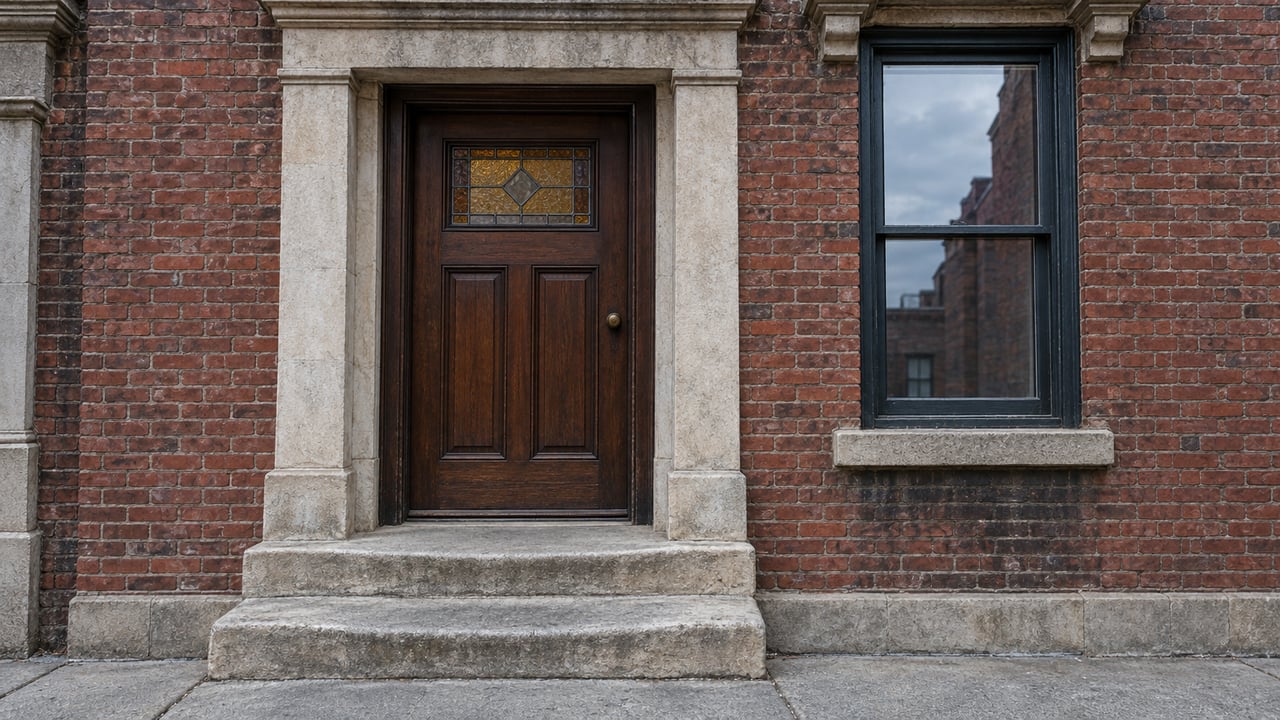
A title search comes back on a rowhome on the 100 block of N. Chapel Street, and there it is: subject to ground rent, $96 a year. The buyer's agent pulls a payoff quote from a similar sale two blocks over and assumes the number will land somewhere close. It doesn't. The house two blocks over redeems for under $800. This one redeems for just over $2,400. Same neighborhood, same style of rowhouse, same annual rent, and a redemption price three times apart.
The gap isn't a pricing error. It's built into Maryland law, and it depends on a fact almost nobody checks before it shows up on a title commitment: the exact year the ground lease was created.
The formula everyone quotes, and the part they leave out
Most explanations of Baltimore ground rent stop at one number: annual rent times 16.66. That figure comes from Maryland Real Property Code Section 8-804, which sets redemption at the annual rent capitalized at a 6 percent rate for a ground lease created at any time other than two specific windows written into the statute.
Those two windows are where the standard explanation runs out of road. A lease executed between April 8, 1884 and April 5, 1888 capitalizes at 4 percent, which multiplies out to 25 times the annual rent. A lease created on or after July 1, 1982 capitalizes at 12 percent, which comes out to 8.33 times the annual rent. Everything else, the overwhelming majority of Baltimore ground rents, redeems at 16.66 times.
On a $90 annual ground rent, close to the city-wide median according to Baltimore's parcel data, that produces three very different payoff numbers:
| Lease created | Multiplier | Redemption on $90/year | Redemption on $120/year |
|---|---|---|---|
| April 8, 1884 to April 5, 1888 | 25x | $2,250 | $3,000 |
| Any other time before July 1, 1982 | 16.66x | $1,499 | $1,999 |
| On or after July 1, 1982 | 8.33x | $750 | $1,000 |
No new residential ground rent has been created in Maryland since the state banned the practice for houses of four units or fewer on or after January 22, 2007. Every ground rent a Butchers Hill buyer encounters today is a legacy instrument tied to a specific recording date, and that date is what decides which row of this table applies.
Butchers Hill built through all three windows
Most Baltimore rowhouse neighborhoods went up fast, in a single construction push. Butchers Hill didn't. Baltimore City's own historic district documentation describes construction dates spanning 1850 to 1915, with development that began slowly in the 1850s, accelerated through the 1870s, and wasn't complete until 1915. The district holds roughly 1,000 buildings, 97 percent of them contributing structures, laid out in small clusters built up over decades rather than a single developer's block-by-block rollout.
That drawn-out construction timeline means a meaningful share of Butchers Hill's original ground leases were recorded squarely inside the narrow 1884-1888 window that triggers the 25x multiplier, right in the middle of the neighborhood's most active building years. A rowhouse a few doors down, built or resold a decade later under a lease recorded after 1888, carries the standard 16.66x rate. Nothing about the two houses looks different from the sidewalk. The lease date sitting in Baltimore City land records is the only thing that separates a $2,250 payoff from a $1,499 one.
The neighborhood's landmark status makes the paper trail easier to trace than in a lot of other places. Butchers Hill was designated a Baltimore City historic district by ordinance in 1981 and 1988, and listed on the National Register of Historic Places on December 28, 1982. Title companies working a Butchers Hill closing are pulling from a well-documented set of land records, which helps confirm a lease's origination date once someone thinks to ask.
The real bottleneck isn't the price, it's finding who to pay
The dollar spread between $750 and $3,000 sounds like the headline, but it's rarely what threatens a Butchers Hill closing date. Redemption itself is a short process on paper.
- Confirm the ground lease is registered with the Maryland State Department of Assessments and Taxation. An unregistered ground rent can't legally be collected or enforced, so this step also tells you whether the holder can even bill for back payments.
- Request the payoff figure and a signed redemption deed from the current ground rent holder.
- Record that deed in Baltimore City land records to convert the property to fee simple.
Step two is where deals stall. A ground lease recorded in the 1880s has typically changed hands several times since, sometimes through a family estate, sometimes sold off in a bundle to an investment company that has since merged, renamed, or dissolved entirely. Locating whoever currently holds a 140-year-old lease and getting them to sign off can take anywhere from a same-day turnaround to several weeks, and most standard Maryland purchase contracts don't build in that kind of runway.
If the holder truly can't be found, Maryland's redemption process allows SDAT to step in after a period of no contact from the ground rent owner, and back rent that can be collected is capped at three years regardless of how long the account went unpaid. The Maryland Department of Housing and Community Development also runs a Ground Rent Redemption Loan Program, established by the General Assembly in 2007, offering interest-free loans to income-eligible homeowners who want to redeem a ground lease on their primary residence. The state assessment office's Ground Rent Office in downtown Baltimore now operates by appointment only at 123 Market Place, which is worth knowing if a title company sends a client there directly rather than handling the registry check remotely.
Maryland law also requires a registered ground rent holder to mail a bill on the state's approved form at least 60 days before a payment is due before they can collect it. Sellers who've paid a semiannual bill for years without giving it much thought are sometimes surprised to learn, once a buyer's title search raises the question, whether their lease was ever properly registered at all.
What this means for a Butchers Hill contract right now
Not every Butchers Hill sale involves ground rent. Ground rent shows up on roughly 27 percent of Baltimore City parcel records citywide, so a good share of closings in the neighborhood never touch this issue. When it does appear on a title commitment, the practical move is to ask two questions immediately rather than assume the payoff will match the last comparable sale: is the lease registered with SDAT, and what year was it created. The answer to the second question determines which of the three multipliers applies, and that in turn determines how much time to build into the contract for locating a holder and recording a deed before closing.
Ground rent is a title item, not a defect. It doesn't affect what the house appraises for or how it lives day to day. It's a paperwork sequence with a deadline attached, and in a neighborhood where construction dates span 65 years, the paperwork looks different from one rowhouse to the next even when the houses themselves look nearly identical.
FAQ
Does every Butchers Hill rowhome have a ground rent attached? No. Ground rent appears on a minority of Baltimore City parcels, so plenty of Butchers Hill sales close with no ground rent line on the title report at all.
Does a ground rent make a house harder to sell? Not typically. It's a title item that gets cleared through redemption, either before listing or as part of the closing process, and it doesn't change the home's condition or appraised value.
Who usually pays to redeem the ground rent, buyer or seller? It varies by negotiation. Some sellers redeem before listing to remove the question entirely. In other contracts, the parties agree to a credit or split the cost at closing.
Ground rent on a Butchers Hill title report isn't a red flag, but it isn't a number you can guess from the house next door either. If you're weighing a purchase or a listing in Butchers Hill and want someone who will check the lease date before quoting a payoff, Brian DiNardo has spent two decades working through exactly this kind of Baltimore City paperwork, one rowhouse at a time.